
Introduction
Implementing Sponsorship in Sports Venues with LED Video Displays—Without Distracting the Fan Experience
Let’s be honest — outside of Super Bowl Sunday, no one really wants to watch a bunch of commercials. Fans come to a ballpark to watch their favorite teams and players. While the modern-day fan realizes that advertising is an integral part of the business of sports, too much is too much. We can deliver effective advertising in an impactful way while still keeping the game front and center.
Modern LED video displays give sports venues an unprecedented opportunity to strike that balance. When implemented thoughtfully, digital signage can elevate sponsorship value, create new revenue streams, and enhance the overall atmosphere of the venue—without pulling attention away from the action on the field.
The business model of sports advertising is only going to get bigger. LED Videoboard systems are constantly reaching bigger and better designs. Big displays cost big dollars, and the return on that investment means advertising will continue to be a huge percentage of what’s displayed.
The goal should be to ROi the investment without “selling out” your presentation.
BREAK DOWN YOUR VIDEOBOARD SPONSOR INVENTORY
An LED display really puts some firepower in to your sponsorship revenue capabilities. It’s important to develop a plan that maximizes the exposure on the videoboard, while also delivering a fan-centric gameday presentation.
Let’s put sponsorship inventory in to a couple specific categories:
- Passive Signage (non-motion)
- Scripted Moments (ex: Time Out Activities)
- In-Game Responsive (ex: First Down)
- Culture (ex: Mascot leading “Fight Song” singalong)
- Stats and Data
The amount of exposure on the video display will drive the amount of revenue each activation can garner for the venue owner. It’s important to plan out a very specific gameplan (a gameday “script”) the itemizes exactly what goes up on the display(s) at each and every moment of the event.
TIP #1 – DESIGN A GAMEDAY PRESENTATION THAT KEEPS THE GAME AS THE PRIMARY ASSET
The guiding principle for any sponsorship strategy should be simple: the game is the hero.
We should never lose focus (from top management to control room staff) that the LED displays are there to ENHANCE the experience. The programmed content should accentuate the experience, not distract.
This means avoiding excessive motion, overly bright content, or rapid creative changes during active gameplay. Static or minimally animated sponsor elements during play, paired with more dynamic content during natural breaks—pre-game, timeouts, innings changes, intermissions, and post-game—help maintain focus where it belongs.
Well-designed LED systems allow operators to instantly switch advertising modes based on game state, ensuring sponsors receive visibility without distracting fans at critical moments.
TIP #2 – CREATE CONTEXTUAL / MOMENT-BASED CONTENT
One of the most powerful advantages of LED displays is contextual relevance. Instead of running generic ads on a loop, sponsorship can be tied directly to moments fans already expect visual information.
Examples include:
- “Power Play” or “Red Zone” sponsorships
- Pitch velocity, shot speed, or player stat integrations
- Replay and highlight sponsorships
- Pre-game lineups and post-game summaries
These are pre-planned “moments” that are ready to go – instantly. This doesn’t happen by accident – they are carefully planned and rehearsed, so when the moment comes the entire production team can quickly spring in to action and sieze the moment.
Here are key steps to executing in-game elements:
- Pick your Moments: Create a very specific list of in-game events that you are available for sponsor placement
- Itemize Deliverables: List out all of the exact piece that the sponsorship entails:
- PA Announcement with sponsors name mention
- Video Animation with the sponsors logo included
- Mascot / Spirit Team / Cheer Team Participation
- Physical placement of dignitaries
- Exact duration of the moment
- Proof of performance (photos and video of the moment)
- Practice, Practice, Practice: these moments happen VERY FAST, so it’s critical that your production team be rehearsed and ready for the moment.
- Communicate Clearly: A “Show-caller” is critical for the team to know what to do next. When a big moment come it’s vital for the team to be able to see, hear and time the steps of the promotion.
By aligning advertising with existing fan-focused content, the sponsor becomes part of the experience rather than an interruption. This approach feels additive, not intrusive.
These scripted events are the big moments we all remember. These are pre-planned moments that should always be ready and waiting for their time to come — and when it does come, it should be perfectly executed.
TIP #3 – QUALITY OVER QUANTITY
A common mistake in digital advertising is over-rotation. It’s just so tempting to sell, sell, sell — and we end up with an unplanned hodge-podge of too many ads that look cluttery and dilute the value of the inventory.
LED technology makes it easy to display more ads, but restraint is critical. Fewer sponsors with higher-quality placements typically outperform cluttered boards filled with constant messaging.
From a fan perspective, clean visuals and predictable placement reduce cognitive fatigue. From a sponsor perspective, premium placement and exclusivity increase recall and perceived value.
The challenge is communication — the sales team and the production crew must communicate.
The best gameday presentations are built when the sales team is offering sponsors inventory that the production team is excited to execute. A well-curated sponsorship mix—rotated strategically throughout the event—creates stronger impressions than an oversaturated display environment.
TIP #4 – BRAND CONSISTENCY CREATES VALUE
Sponsor content should live within the visual ecosystem of the venue/team. This includes color palettes, typography, transitions, and overall production quality.
Venues that provide sponsors with creative guidelines—or even production support—tend to deliver more cohesive, premium-feeling experiences. When ads visually align with team branding and scoreboard graphics, they feel intentional rather than intrusive.
Keeping a consistent “look” can be challenging for a number of reasons:
- The sheer volume of “stuff” that everyone wants to be displayed on the screen during a game gets everwhelming and can become very scattered-looking.
- Sponsors can be very pushy about wanting “their look” to over-ride your game presentation guidelines. Strong creative direction needs to come from the team/venue.
- Smaller venues do not have a large staff, so absorbing the workload of handling creative design and production presents a challenge.
- It’s difficult to get everyone on the same page with design expectations. Having a central person (“Producer”) that implements good communication is critical to building a good production plan in a cohesive look.
It’s a lot of work to develop consistency in a game presentation — this consistency elevates sponsor perception, associating their brand with professionalism and quality.
TIP #5 – OFFER SPONSORS THE MOMENTS FANS WANT TO SEE
In 1993, Paul Allen broke ground on his new state-of-the-art Rose Garden Arena, that would be home to the Portland Trailblazers, and he had one very clear mission statement for that building — he wanted to Trailblazer season ticket holder to be the most-informed AND most-comfortable fan in the NBA.
Mr. Allen put great effort and resources in to the video and signage displays in his new arena. At that time, no one was really keeping track of little details, like how many points off of turnovers each team had. He put in a dedicated “Hustle Board” that displays some very intricate stats — certainly more detailed info than the typical sports venue had in 1993!
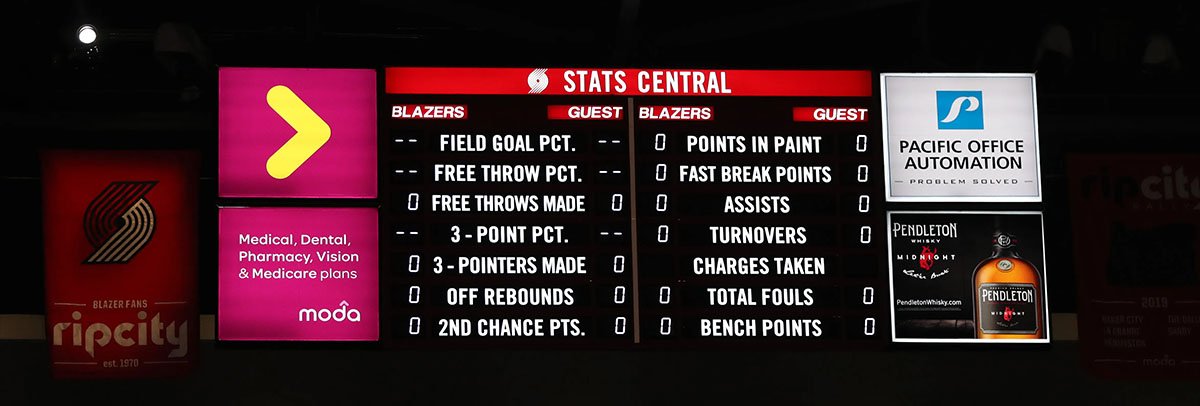
Imagine the ease of sale the Traiblazer Ad Sales team had when selling exposure on this display. Now, obviously we have moved well in to the digital LED age of endless stats, but the point is that giving fans what THEY want to see will easily incorporate non-intrusive sponsor opportunities.
The best type of sponsorship is when the fans enjoy the moment.
Kiss cams, noise meters, and big touchdown moments are all big moments of the game — but there are many more opportunities to add sponsorship to key moments that fans really want in their game experience.
CONCLUSION
The goal is not to eliminate advertising, nor should we let it run rampant and out of control —the best venues make advertising sponsorship feel like it belongs. When done right, fans stay focused on the game while sponsors feel highlighted and everyone in the situation can reap the reward of a well-executed sponsor activation.
The most successful sports venues understand that the fan experience and sponsorship revenue are not opposing forces. When LED video displays are used with intention, discipline, and respect for the game, they create a win-win scenario: fans stay immersed in the action, and sponsors benefit from high-impact, memorable exposure.
BOOK A CONSULTATION CALL
Our Creative Team is more than happy to walk you through the process and help you determine exactly what elements you will need, and how to customize them for your best application.